Manufacture of chamomile essential oil
Karina-Agro Ltd. manufactures essential oils from German Chamomile (Matricaria Chamomilla) and Roman Chamomile in its own essential oils distillation plant. The entire process of crop cultivation and raw material processing is fully automated from the harvesting of the plants to the extraction of the essential oil using high-performance machines.
The chamomile flowers contain a large number of active substances, such as 0.2 to 0.8% essential oil, bitter substances, slime, tannins, phytosterol, dioxy coumarin, glycosides, proteins and other as of yet unspecified components. Thanks to the active properties of these substances, chamomile has been a well-known and popular medicinal herb for centuries in folk medicine and is often used to treat various diseases. It is also used in medicine as an anti-inflammatory drug. The essential chamomile oil and the azulene in it have a shrinking and anti-inflammatory effect on the dilated capillaries. Glycosides, on the other hand, provide relaxation of the autonomic nervous system and smooth muscles and help alleviate cramps and pain.
Apart from medicinal use, chamomile essential oil is used as a solvent of paints for painting items from porcelain and faience.
The largest wildlife chamomile habitats are found in the Mediterranean countries. However, it has spread across Europe and Asia for centuries.
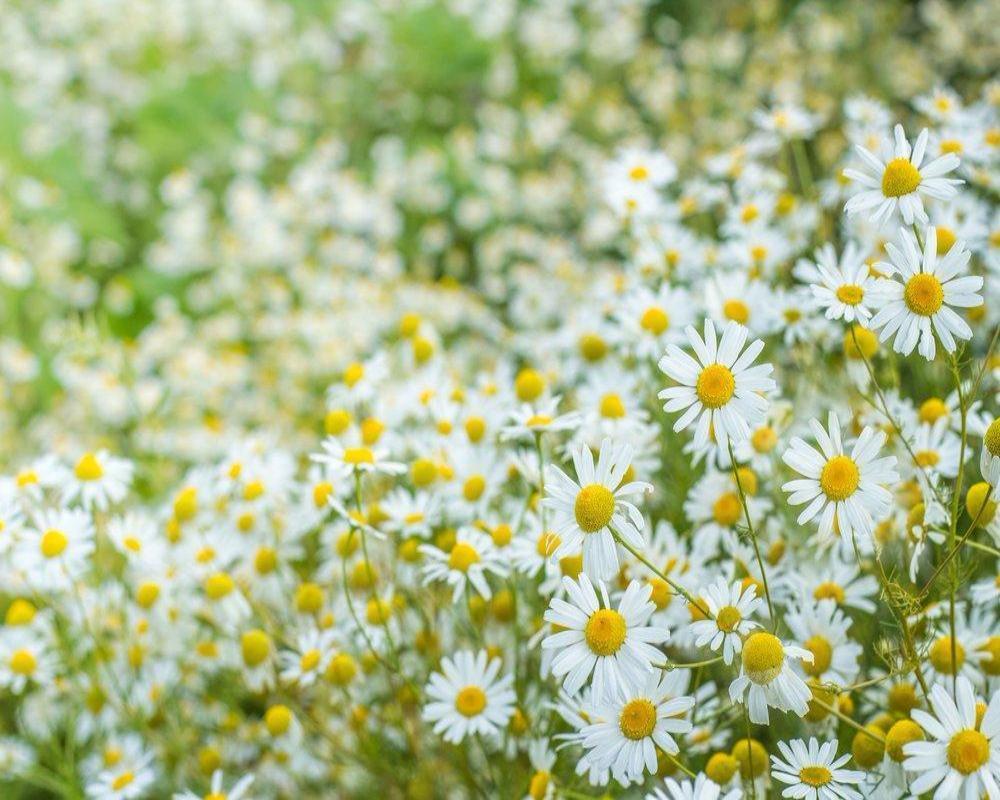
Chamomile is an annual herbaceous plant of the family Asteraceae.
The root system of the chamomile is poorly developed and brown-colored. The stem is bare, ascending, heavily branched and can reach a height of up to 50 cm.
The leaves are seated, double-pinnate, strongly jagged into narrow parts with pointed tips.
The inflorescences are small capitula located at the tops of the branches. The flower bed is conical, bulging and hollow. The florets are arranged on it. The peripheral florets are unisexual, dentate and white, and the inner ones are bisexual, tubular and yellow.
The flowering season of chamomile is during the second half of the summer.
The fruits (seeds) of the chamomile are oblong with smooth outer sides and 3-4 white longitudinal ribs. They are very small. The weight of one thousand seeds is from 0.0264 to 0.0527 grams.
The essential oil of chamomile accumulates predominantly in the intercellular spaces of the flower bed, the petals and the pistil. It has a blue color.